Table Of Content

One reason so many of us don’t remember much of what we learned in school is that we learned it through this haphazard, topic-driven approach. These random activities are taking up precious time that could be spent on much more valuable stuff. This is the same philosophy that follows many standardized tests in public schools around the country. Public school teachers will often “teach the test” by focusing primarily on what will be on federal or state standardized tests instead of other content or modules in textbooks. Do you have a final exam surrounding a few modules from a book or from an online class? Make sure that the exam has a section for each module so students can study the entire course’s material from start to finish.
Developing a backward design lesson plan step by step
2024 Mercedes-Benz E-Class Preview - J.D. Power
2024 Mercedes-Benz E-Class Preview.
Posted: Wed, 26 Apr 2023 07:00:00 GMT [source]
You then develop assignments that will help students practice and meet those outcomes. Decisions about course content and teaching strategies appear last, guided by reflection on what students will need to demonstrate their learning. As previously stated, backward design is beneficial to instructors because it innately encourages intentionality during the design process. It continually encourages the instructor to establish the purpose of doing something before implementing it into the curriculum.
Learner-Centered vs Content-Centered Approach
Browse over 500+ educator courses and numerous certificates to enhance your curriculum and earn credit toward salary advancement. Please consider supporting us and gaining full access - click here to become a member.
Evolution Over Time
Some states in the U.S., like Massachusetts and North Carolina, even began incorporating elements of Backward Design into their educational standards. Instead of starting with the first clue, you begin by planting the treasure—your final learning goal. Backward Design is a way of planning lessons or training sessions by starting with the end goal in mind.
This educational theory was primarily influenced by the works of Jean Piaget, a Swiss psychologist, who introduced these ideas in the mid-20th century. According to Piaget, learning is a process where individuals construct knowledge based on their experiences. Now you might be wondering, "Isn't this how all teaching is done?" Not exactly. The old-school way of designing lessons—let's call it "Forward Design"—starts with the teaching materials and activities, sort of like making up the clues for your treasure hunt before you even know where the treasure is hidden. A unit or sequence of lessons framed around enduring understandings and essential questions.
Share This Book
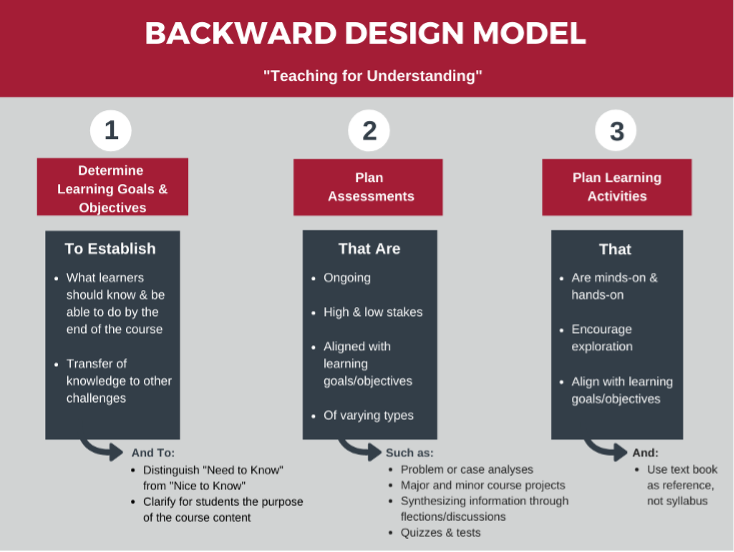
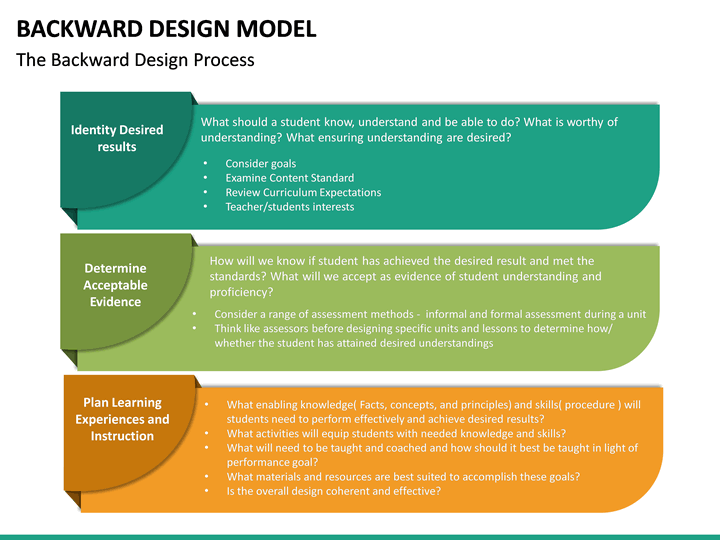
In order to define the goals or learning outcomes for the course, you will need to formulate a clear idea of what students should know, understand, and/or be capable of doing. In addition, it is helpful to ask yourself what the impact of the course will be on students, and how you hope they will be different by the end of it. And there we have it—a comprehensive look at Backward Design, from its origins and methodology to its benefits, challenges, comparisons with other frameworks, and practical tips for implementation. We hope this guide serves as a valuable resource for educators and curriculum designers alike, offering insights and strategies to enhance teaching and learning for all. Just like any plan, your initial Backward Design framework may require adjustments.
Stage 3: Lesson Planning
However, these ILOs still communicate crucial information to students about what good communication looks like to the instructor and help them better understand what will be expected of them in the course. In the well-known book The Seven Habits of Highly Effective People, author Dr. Stephen Covey describes seven habits that successful people tend to live by. The second habit is “Begin with the end in mind.” Dr. Covey was suggesting that the most successful people are those who create a vision of the future in their mind. They determine what they want to be and do, and then take actions to reach that result.
Basic Steps of Backward Design Lesson Plans
Backward Design focuses on what students need to know, understand and be able to do as a result of provided instruction[3]. The desired result is the catalyst for all related instructional and assessment planning. Emphasis is placed on essential questions and what is most important for students to understand and know (student learning), rather than on materials, topics and content an instructor might be most comfortable with (student teaching). Student understanding is a central focus of the backward design methodology[3].
Integration into Curriculum Planning
Backward Design is an instructional design approach that begins by first defining the desired outcomes and objectives and then creating the assessments, instructional activities, and materials to help learners achieve those outcomes. This approach to curriculum and lesson planning prioritizes learning objectives, resulting in more effective and purposeful teaching and more student-centered and engaging learning experiences. Backward design is a method of curriculum planning in which standards are aligned with assessments and lesson plans through the use of a 3-stage process. It was discussed in the book Understanding by Design by Grant Wiggins and Jay McTighe.
The idea of Backward Design comes from Wiggins & McTighe and suggests that learning experiences should be planned with the final assessment in mind. There are lots of advantages to using backward design for your lesson plans. For starters, it ensures that your students will never be flabbergasted or taken by surprise by testing materials. They will never sit for a test and not know what the test is talking about or what he wants them to do. Unfortunately, this results in tests or assessments that don’t always reflect what the students did or learned. We’ve all experienced an unfortunate class or two where the test didn’t seem to reflect anything we had learned in lessons or course materials up until that point.
This approach applies to any field, including business, the sciences and STEM. Assessment refers to the wide variety of methods or tools that educators use to evaluate, measure, and document the academic readiness, learning progress, skill acquisition, or educational needs of students. Bloom’s Taxonomy is a great tool in helping to identify action verbs appropriate for measurement. Use specific action verbs to express exactly the kinds of skills you want your students to develop.


No comments:
Post a Comment