Table Of Content
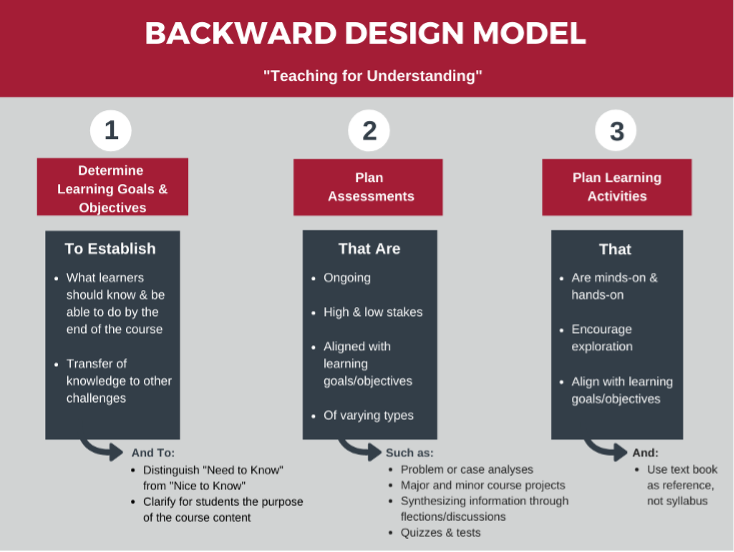
It is important to note here that assessment should not be limited to one test at the end of a unit. Effective assessment is ongoing, and begins before new content is even introduced. The traditional approach to education planning, sometimes called "Forward Design," usually starts with content and activities. Teachers first decide what to teach (content), then how to teach it (methods and activities), and finally, how to evaluate learning (assessment). Whatever the case may be, there is an alternative approach that helps instructors avoid these pitfalls and mitigate student frustrations with their learning experiences.
Universal Design for Learning: Planning with All Students in Mind
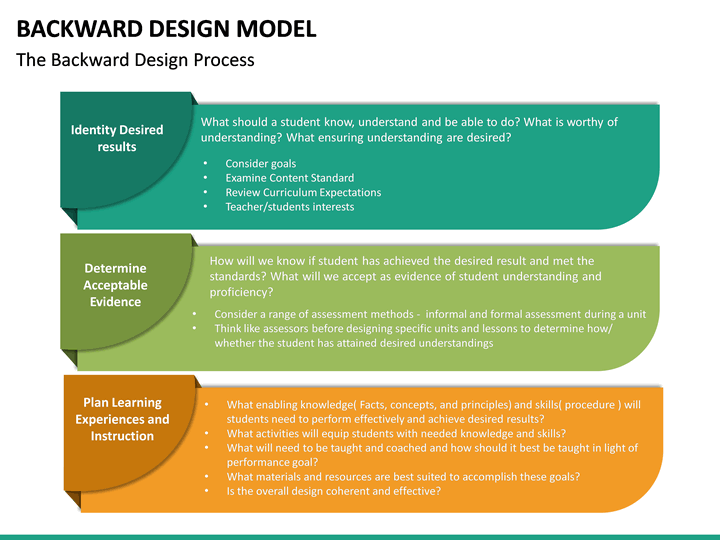
You study standards, learning objectives, or profit margins, then create your lessons and learning materials based on those goals. This lesson planning template will walk teachers through the three steps of the backwards design process in order to plan an effective lesson. It will begin with writing a clear content objective, then move onto creating an effective assessment that measures student mastery of the content objective, and finish with choosing appropriate instructional activities. Finally, instructors create learning activities and instructional materials that align with and support the achievement of the learning objectives.
Psychology Resources
Some argue that this model places too heavy a focus on the result (or test) at the expense of the learning journey or experience[2]. Others caution that there are risks of incorrectly identifying which knowledge is essential for students to understand. There are concerns for too narrow a focus on results, where a design does not address all elements of a lesson or workplace needs and results in little flexibility to incorporate alternate paths to achieve a final goal. Finally, the Backward Design process can be time consuming (to learn and in practice)[3].
Additional Resources
Although backward design is based on the same components of the ADDIE model, backward design is a condensed version of these components with far less flexibility. In backward design, you build your course not around predetermined assignments and activities, but around the skills and knowledge you want your students to gain from the experience. In backward design, you anchor the development of a course in a careful articulation of the learning goals—just what it is that you want students to learn—and work backward from there. The backward design model is a model in which a curriculum is created from the learning objectives outwards. In contrast, a forward design model focuses on the creation of learning activities and lesson plans first; the backwards model creates these elements last so that they are informed by the learning objectives. Each of these educational frameworks has its merits, but Backward Design stands out for its focus on alignment between learning objectives, assessments, and instructional strategies.
Comparing Backward Design to Other Educational Frameworks
For educators looking to align their teaching methods with desired learning outcomes, Backward Design offers a robust, flexible framework. Whether you're teaching in a traditional classroom, a corporate setting, or an online platform, taking the time to plan backward can lead to more effective, engaging, and meaningful learning experiences. Now it is time to plan the lessons, determine reading assignments, method of instruction, and other classroom activities to support student learning. With students’ needs in mind, instructors can choose the most appropriate methods to help their students achieve the learning objectives. A content-centered approach to instructional design risks creation of poorly-defined learning experiences where students aren’t clear on how the learning activities or learning objectives are supposed to support their learning of the content. After an exam, for instance, instructors might hear students express their frustration with statements such as, “that test wasn’t fair” or “that question came out of left field”.
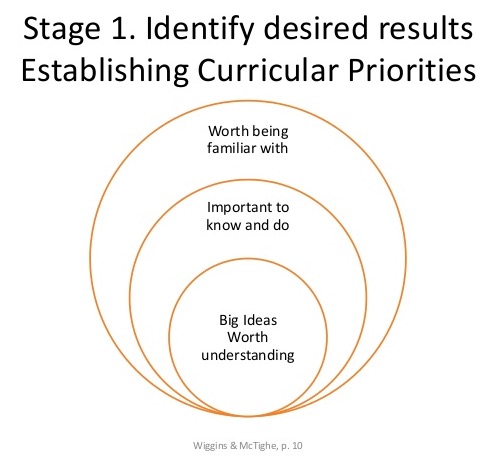
Remember that “students” is the subject of the generic learning outcome stem shown at the beginning of this section. The goals for your course should not be stated in terms of what the instructor will cover, but rather in how the students will change, facilitated by the instructor’s guidance. Educators like Lorin Anderson, who revised Bloom's Taxonomy, appreciate that Backward Design encourages higher-order thinking skills. Because educators start with the end in mind, they can plan activities that go beyond rote memorization, facilitating skills like analysis, evaluation, and creation. This helps students become not just passive receivers of information, but active constructors of knowledge.
ANN and RSM approach for modeling and optimization of designing parameters for a V down perforated baffle ... - ScienceDirect.com
ANN and RSM approach for modeling and optimization of designing parameters for a V down perforated baffle ....
Posted: Sun, 24 Dec 2017 09:03:27 GMT [source]
Instructional activities are the specific ways in which students interact with the course content. These activities run the gamut from watching educational videos, creating posters or presentations, completing a group project or playing learning-based games. Successful lesson plans often contain a mix of instructional strategies and activities, since asking students to adapt to different modes of learning is an effective way to keep them engaged. 'Begin with the end in mind' is the second tenet of Stephen Covey's The 7 Habits of Highly Effective People. In essence, this is the thought process behind the Understanding by Design (UbD) framework.
Once you have worked through the three steps of backward design, you should make sure that all elements (objectives, assessments, learning activities, and instructional materials) align with each other. In this template, think of goals as the course learning outcomes (CLOs), the essential understandings as the core concepts and competencies, and performance tasks as the learning objective. For your most important learning outcomes, you may need to develop multiple opportunities to measure students' progress over the duration of the course.
Is It Suitable for All Learners?
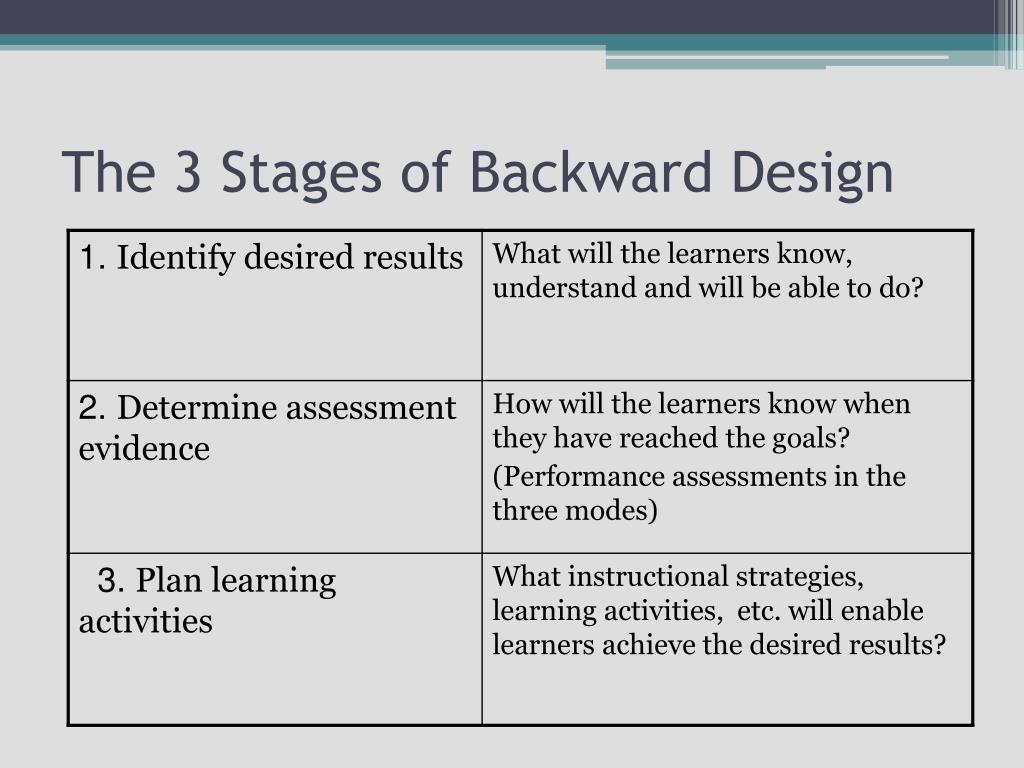
The backward design method goes the other way around, instead starting with the learning objectives which are determined by the standards students should be meeting at a given grade level. From there, assessments are developed based on those standards as a means of testing students in relation to standards. Then, finally, lesson plans can be constructed to best prepare students for the assessments. As a strategy for designing, planning, and sequencing curriculum and instruction, backward design is an attempt to ensure that students acquire the knowledge and skills they need to succeed in school, college, or the workplace.
This could be particularly problematic in subjects like the arts, where creative exploration is key. The rigidity of the Backward Design framework has also been critiqued by educators like Sir Ken Robinson, who champion the benefits of creativity and freedom in educational settings. Educational scholars like Alfie Kohn have raised concerns that an approach like Backward Design, which starts with outcomes and assessments, might place too much emphasis on testing and grading. However, proponents argue that the time investment upfront often leads to more effective and efficient teaching down the line. Finally, the Zone of Proximal Development, a concept introduced by Russian psychologist Lev Vygotsky in the early 20th century, also supports the effectiveness of Backward Design.
(26 PD Hours) In this course, participants will learn the importance of and how to align your instructional strategies and activities with your learning objectives and plans for assessments. This phase is essentially a way of helping you structure evaluative strategies into the course design so that you are able to gauge students’ progress towards the desired learning outcomes. A defining feature of Backward Design is its alignment between learning objectives, assessments and feedback, and learning activities and instructional materials.
The backward design approach for curriculum development applies to individual lesson plans through the backward mapping approach. Traditionally, instructors have applied a forward or content-centered approach to designing lessons, modules, or courses. This approach typically ends with crafting learning objectives to connect the content learned to the assessments. Alignment is the degree to which learning objectives, assessments, learning activities, and instructional materials work together to achieve the desired course goals. Rather than starting with decisions about course content, the backward design process begins by asking you to determine what you want students to learn.
Lists the learning activities that will lead students to the desired results. However, the backward design approach provides an authentic learning experience relevant for both the educator and the student when deployed effectively. Using anticipated learning outcomes for backward design of a molecular cell biology Course‐based Undergraduate Research Experience.
(Wiggins and McTighe, 2005) It is thus “backward” from traditional design because instead of starting with the content to be covered, the textbook to be used, or even the test to be passed, you begin with the goals. As you can see, there are lots of advantages to implementing backward design lesson plans into your curriculum or teaching schedule at the earliest opportunity. Fortunately, using backward design lesson planning is easy once you make a few classes or courses with this philosophy in mind. The right backward design lesson plan may result in a better learning experience for a classroom full of students, a private client, and everyone in between. We’re going to break down what backward design lesson planning is and why you should use it.
This general life lesson can be applied in a classroom setting as teachers plan their lessons based on what they need their students to know. There are, of course, numerous evaluative methods (i.e. essays, term papers, quizzes, lab projects etc.) that can give you feedback on students’ progress, knowledge, and skill level. However, not all of them are appropriate for every type of course, and knowledge. However, not all of them will be appropriate for every course, so it is important to choose those that align most closely with your learning goals, so that you can be sure you are testing for exactly what you want them to learn.
Using the ratio example, the teacher would need to ensure their students have a solid understanding of multi-digit multiplication, division, factors and multiples. If students enter sixth grade without competent skills in these areas, the teacher will need to build appropriate units into their lesson plans to achieve the year-end goal of understanding ratios. “Backward Design” is an approach to creating curriculum, subjects, and even single class sessions that treats the goal of teaching as not merely “covering” a certain amount of content, but also facilitating student learning. Backward design prioritizes the intended learning outcomes instead of topics to be covered.